MARKETING
Google reviews are one of the three biggest factors in local search rankings — alongside your Google Business Profile optimization and your website’s local SEO structure. More specifically, Google looks at the number of reviews, the average star rating, the recency of reviews, and whether you’re responding to them.
Most businesses ask for reviews inconsistently, at the wrong moment, or not at all. Here’s what actually works.
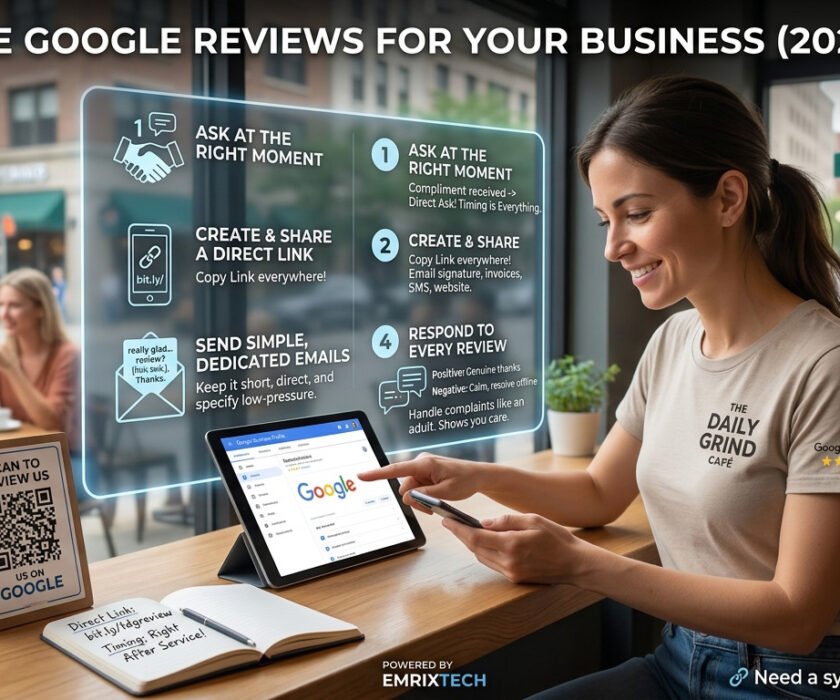
Ask at the Right Moment — Timing Beats Everything
The best moment is right after a positive interaction — the end of a successful project, a compliment from a satisfied client, a smooth customer service resolution. The goodwill is fresh and the motivation is there.
Timing isn’t a small detail — it’s the single biggest lever. A service business that sends a review link within 30 minutes of finishing a job can see 30–40% of customers leave a review. Sent 72 hours later, that same request often converts below 5%. Build the ask into your job-completion workflow, not your follow-up workflow.
Waiting a week to send a review request is too long. Asking before the job is done is presumptuous. Right after something went well, while the customer still has positive feelings — that’s the window. Don’t waste it.
Create a Direct Review Link and Share It Everywhere
A direct review link takes your customer straight to the review box — no Googling your business, no navigating your profile, no searching for where to click. Every extra step loses some percentage of people who would have left a review.
To get your link: go to your Google Business Profile dashboard, find the “Get more reviews” option, and copy the short link. Test it yourself first — it should open the review box immediately. Put this link in your email signature, your invoices, your post-project follow-up emails, and your website footer.
The Email That Actually Gets Reviews Written
Keep it short. A long, formal review request email doesn’t outperform a simple, direct one. Here’s the structure that works:
“Hi [Name], really glad the project went well. If you have 2 minutes, a Google review would mean a lot to us — it helps local customers find us. Here’s the direct link: [link]. No pressure at all. Thanks.”
That’s it. Specific, low-pressure, easy to act on. The “no pressure” line is worth including — it removes the awkwardness and paradoxically increases compliance because it doesn’t feel like a demand.
Match Your Collection Method to Your Business Type
The best review channel depends on how you interact with customers:
Service businesses (HVAC, plumbing, contractors, cleaning):
- Verbal ask at job completion: “If you’re happy with the work, I’ll text you a review link right now.”
- Text within 30 minutes of finishing, with the direct link.
- Automated follow-up email 24 hours later if no review appears.
Retail and restaurants:
- Train staff to mention reviews to happy customers at the point of sale.
- QR codes on receipts and table cards linking straight to your review page.
- A review request inside your post-visit email.
Other Ways to Collect Reviews
- QR code on receipts, invoices, or business cards linking directly to your review page
- In-person ask at the end of a service — “If you’re happy with how it turned out, a Google review really helps small businesses like ours”
- SMS follow-up for mobile-heavy customer bases — short message, direct link, sent within hours of a positive experience
- Email signature with a “Review us on Google” link for all outgoing emails
Respond to Every Single Review
Respond to every review — positive and negative. For positive reviews, a brief, genuine response works better than a formulaic “Thank you for your kind words!” For negative reviews, respond within 24 hours, acknowledge the issue without getting defensive, and offer to resolve it offline.
Potential customers read your negative review responses more carefully than your positive ones. A measured, professional response to a complaint often reassures people more than a wall of five-star ratings with no context. It shows you’re a real business that handles problems like an adult.
How Many Reviews Do You Actually Need?
It depends entirely on your category and geography. In some Naperville suburbs, 15 reviews can put you in the map pack. In competitive Chicago categories, you might need 80 or more. The benchmark isn’t a number — it’s your competition.
Check what the top three map pack results have for your target keywords. That’s your near-term goal. Focus on consistently getting more reviews than your nearest competitor, not on hitting some abstract number.
For more on how reviews fit into your overall local ranking strategy, read our guide: Local SEO in Chicago: The Complete 2026 Guide.
Frequently Asked Questions
Can I offer discounts or incentives for Google reviews?
No. Google’s terms of service prohibit incentivizing reviews, and it can get your listing penalized. The ask needs to be unconditional — you’re requesting an honest review, not purchasing one.
A customer left a fake negative review. What can I do?
Flag it in your Google Business Profile as inappropriate. Google reviews flagged content, and demonstrably false or fraudulent reviews can be removed, though it’s not a fast process. In the meantime, your response to that review matters — calm, professional, and factual.
Do old reviews count less than new ones?
Yes, recency matters to Google’s local ranking algorithm. A business with 50 reviews from 2021 and nothing since will rank below a competitor with 20 reviews, half of them from the last 3 months. Consistent review flow beats one-time bursts every time.
Should I respond to every positive review?
Ideally yes. A brief, genuine response signals to Google that your profile is actively managed and shows potential customers that you care about feedback. Something like: “Thanks, [Name] — really glad we could help.” Short and human beats long and formulaic.
How do Google reviews affect my search ranking?
Google uses review quantity, average rating, recency, and response rate as local ranking signals. More reviews from the last 90 days, a high average rating, and consistent responses all contribute to higher map pack rankings. Reviews are one of the fastest-moving signals you can directly influence.
Related Reading:
How to Get My Business on Google Maps (2026 Guide)
Local SEO in Chicago: The Complete 2026 Guide
How to Rank Your Business on Google in 2026
Why Is My Website Not Showing on Google?
GEO: How to Get Cited in AI Search 2026
Want help building a review acquisition system for your Chicago-area business? Talk to EmrixTech — local SEO and review strategy is core to what we do.