DEVELOPMENTMARKETING
Let’s be honest — most small business owners don’t lie awake at night thinking about meta tags or crawl budgets. You’re thinking about your next client, your team, your product. But if your business isn’t showing up on Google when someone searches for what you offer, you’re leaving a lot of money on the table. Ranking your business on Google in 2026 isn’t about gaming the system. It’s about showing up consistently, looking credible, and making it easy for the right people to find you.
This guide is written for real business owners — not SEO nerds. We’ll walk you through exactly what it takes to rank your business on Google in 2026, what’s actually changed from previous years, and what you should focus on first. No jargon overload, no empty promises.
Why Google Rankings Still Matter More Than Ever in 2026
You might have heard that AI tools like ChatGPT are “replacing Google.” Let’s put that to rest: Google still owns over 90% of the global search market. When someone in your city needs a web developer, an SEO agency, or a graphic designer, they’re still going to Google first. The businesses that rank on page one get the clicks, the calls, and the clients. Everyone else might as well be invisible.
What HAS changed is how Google decides who ranks. In 2026, it’s not enough to stuff your pages with keywords or buy a hundred backlinks from shady websites. Google’s algorithm has gotten genuinely good at judging quality — so the businesses that win are the ones that build real authority, answer real questions, and create real value for their audience.
And there’s a new layer worth knowing about: Generative Engine Optimization (GEO) — the practice of getting your content cited inside AI-generated answers from ChatGPT, Perplexity, and Google AI Overviews. Traditional SEO and GEO work side by side in 2026. This guide covers the SEO side; our GEO guide covers the rest.
Step 1: Claim and Optimize Your Google Business Profile
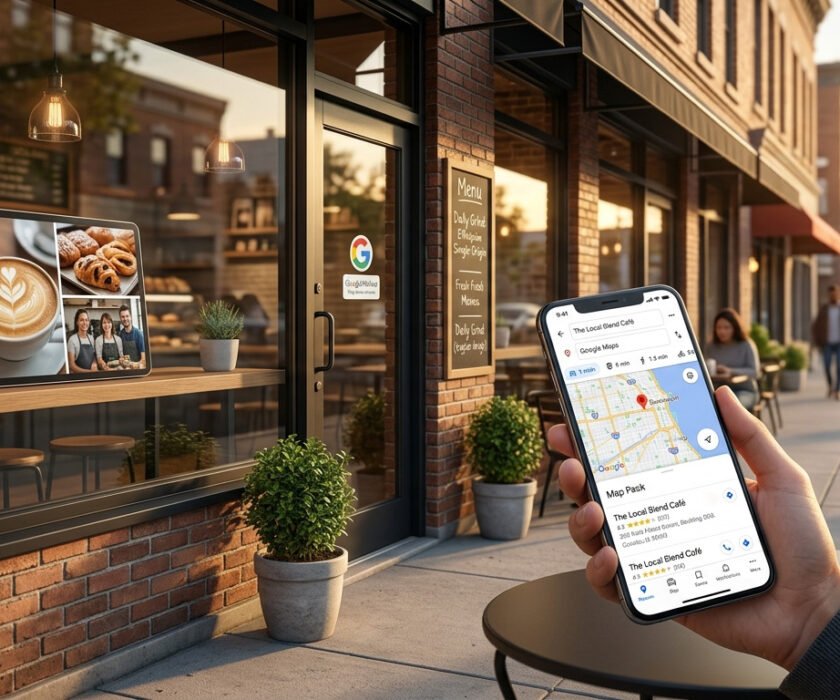
If you do nothing else from this guide, do this. Your Google Business Profile (formerly Google My Business) is the single most powerful free tool for ranking in local search. It’s what shows up in the map pack — those three business listings with stars and phone numbers that appear at the top of Google when someone searches “SEO agency near me” or “web developer Chicago.”
For a complete breakdown of local ranking signals, Google Business Profile optimization, and neighborhood-specific strategies for Chicago, read our detailed Local SEO Chicago guide — it goes much deeper on everything covered in this step.
Here’s what a well-optimized Google Business Profile looks like:
- Complete every field. Business name, address, phone number, website, hours, categories — all of it. Google rewards completeness.
- Choose the right primary category. If you’re a digital marketing agency, “Digital Marketing Agency” is your primary category — not “Marketing Agency” or “Advertising Agency.” Be specific.
- Upload real photos. Businesses with photos get significantly more clicks than those without. Add photos of your team, your office, your work. Update them regularly.
- Write a keyword-rich description. You get 750 characters. Use them. Mention your core services, your location, and what makes you different.
- Get reviews — and respond to all of them. Reviews are one of the strongest local ranking signals. Ask every satisfied client to leave a Google review. Respond to every review, positive or negative. It shows you’re active and engaged.
- Post regularly. Google Business Profile has a posts feature. Use it to share updates, offers, and blog content. It signals that your business is active.
Step 2: Get Your Website’s Technical Foundation Right
You can write the best content in the world, but if your website is slow, broken, or hard to navigate, Google won’t rank it. Technical SEO isn’t glamorous, but it’s foundational. Think of it as making sure your house is structurally sound before you decorate it.
If you’re considering building or redesigning your website, our guide to web design for small business in Chicago covers exactly what a properly built site needs to rank and convert in 2026 — including speed, mobile design, and local SEO integration from day one.
Page Speed Is Non-Negotiable
Google uses Core Web Vitals as a direct ranking factor. These are measurements of how fast your page loads, how stable your layout is, and how quickly users can interact with it. In 2026, a slow website is a penalized website. Run yours through Google PageSpeed Insights — if your score is below 70, you’ve got work to do.
Common culprits for slow sites: unoptimized images (convert to WebP format), too many plugins, no caching, unminified CSS and JavaScript, and cheap hosting. Fixing these can dramatically improve both your rankings and your conversion rate — because users leave slow sites immediately. If your site traffic is already decent but leads aren’t coming in, read our guide on why small business websites don’t convert — slow speed is just one of seven common culprits.
Mobile-First Is Now the Only Way
Google indexes the mobile version of your website first. If your site doesn’t look and work perfectly on a phone, you’re fighting an uphill SEO battle. More than 60% of web traffic comes from mobile devices today — your site needs to be designed for a thumb, not a mouse cursor.
HTTPS Is Table Stakes
If your website URL starts with “http://” instead of “https://”, fix it today. An SSL certificate is free with most hosting providers and takes about 10 minutes to install. Without it, browsers warn visitors that your site is “not secure” — which tanks both your conversions and your SEO.
Step 3: Do Keyword Research the Right Way
Keyword research is how you figure out what your potential customers are actually typing into Google. It’s not about guessing — it’s about data. And doing it right is what separates businesses that rank for terms that bring in leads versus businesses that rank for terms nobody searches.
Here’s the framework we use at EmrixTech when doing keyword research for clients:
Start With What Your Customers Say
What words do your clients use when they describe their problem? Not the technical terms you use internally — the plain language they actually speak. A client doesn’t search “WordPress CMS implementation.” They search “how to build a website for my business.” Start there.
Focus on Search Intent
Every search query has an intent behind it. In 2026, Google is remarkably good at matching intent to content. There are three types of intent you need to understand:
- Informational — “What is SEO?” (The person is learning)
- Consideration — “Best SEO agencies in Chicago” (The person is comparing options)
- Transactional — “Hire SEO agency Chicago” (The person is ready to buy)
For driving leads and revenue, focus your service pages on transactional keywords and your blog content on informational keywords that attract potential clients early in their journey.
Target Long-Tail Keywords
Rather than trying to rank for “SEO” (impossible unless you’re Moz or Ahrefs), target longer, more specific phrases like “affordable SEO services for small businesses in Chicago” or “how to rank my restaurant on Google.” These long-tail keywords have lower competition, higher conversion rates, and are far more realistic for a growing business to rank for.
Step 4: Create Content That Actually Helps People
Content is still king in 2026 — but the definition of “good content” has evolved. Google’s E-E-A-T framework (Experience, Expertise, Authoritativeness, Trustworthiness) now heavily influences rankings. Generic AI-generated fluff doesn’t cut it anymore. What works is content that clearly comes from real human experience and genuine expertise.
Answer the Actual Question
Don’t write around the topic — write to it. If someone searches “how to rank on Google Maps,” give them a step-by-step answer in the first two paragraphs, then go deeper. Articles that bury the lead get abandoned. Google notices that abandonment and ranks the article lower over time.
Write Like a Human, Not a Robot
Readers in 2026 can immediately smell AI-generated content that lacks genuine insight. Use real examples from your work. Share your actual opinions. Mention specific situations your clients have faced. This kind of firsthand experience is exactly what Google’s E-E-A-T guidelines reward — and it’s what builds trust with readers who are deciding whether to hire you.
Publish Consistently
One exceptional blog post per month beats four mediocre ones. But consistency matters — Google rewards websites that are regularly updated with fresh, relevant content. Set a realistic publishing schedule and stick to it. Even one well-researched, genuinely helpful article per month will compound significantly over a year.
Step 5: Build Internal Links Across Your Website
Internal linking is one of the most underrated SEO strategies. When you link from one page on your site to another, you’re doing two things: helping Google understand the structure and relationship between your content, and keeping visitors on your site longer (which improves your engagement metrics).
For example, if you write a blog post about Google Ads tips, link to your Google Ads management service page. If you write about website performance, link to your web development service page. This tells Google which of your pages is most important for each topic and passes ranking authority throughout your site.
Step 6: Earn Quality Backlinks (Not Quantity)
A backlink is when another website links to yours. Google treats backlinks as votes of confidence — but not all votes are equal. A single link from a respected industry publication is worth more than a hundred links from random, low-quality websites. And in 2026, link schemes (buying links, link farms) don’t just fail to work — they can actively get your site penalized.
How do you earn quality backlinks legitimately? By creating content worth linking to. Original research, comprehensive guides, free tools, and genuine expert opinions get linked to naturally. You can also reach out to industry publications, local business organizations, and complementary businesses to explore partnership content and guest posting opportunities.
Step 7: Track What’s Actually Working
SEO without measurement is just guessing. You need to know which keywords are bringing you traffic, which pages are converting visitors into leads, and where your rankings are trending over time. Set up these two free tools if you haven’t already:
- Google Search Console — Shows you exactly which keywords your site ranks for, how many clicks you’re getting, and any technical issues Google has found.
- Google Analytics 4 — Shows you where your visitors are coming from, how long they stay, what they do on your site, and whether they convert into leads.
Review these monthly. SEO is a long game — results typically take 3–6 months to become clear — but the data will tell you whether you’re moving in the right direction.
How Long Does It Actually Take to Rank on Google?
This is the question every business owner asks, and the honest answer is: it depends. For a brand-new website with no existing authority, expect 6–12 months before you’re ranking competitively for meaningful keywords. For an established site making targeted improvements, you can see measurable gains in 2–4 months.
What accelerates the timeline? Targeting less competitive long-tail keywords, fixing urgent technical issues, building a few quality backlinks, and publishing consistently. What slows it down? Slow site speed, thin content, no inbound links, and ignoring mobile optimization.
The key mindset shift is this: SEO isn’t a campaign with an end date. It’s an ongoing investment that compounds over time. Every page you publish, every backlink you earn, every technical issue you fix adds to a growing foundation of digital authority that pays dividends for years.
While SEO builds your long-term foundation, Google Ads for small business can fill your pipeline immediately. Most successful Chicago businesses run both in parallel — Ads for short-term leads, SEO for long-term growth.
Common SEO Mistakes Small Businesses Make (and How to Avoid Them)
In working with hundreds of businesses across the USA, UAE, Kuwait, Australia, and India, our team at EmrixTech has seen the same mistakes come up again and again. Here are the big ones:
- Targeting keywords that are too broad. “Marketing” or “web design” are impossibly competitive for a growing business. Go specific, go local, go niche.
- Ignoring local SEO. If you serve a specific city or region, local SEO — Google Business Profile, local citations, location-specific content — should be your priority, not chasing national keywords.
- Publishing content and forgetting about it. Old content that’s outdated, inaccurate, or no longer relevant can hurt your overall site authority. Refresh your content regularly.
- Expecting instant results. SEO is a marathon. Businesses that bail after two months of “no results” never give it a real chance. Stick with it.
- Not having a clear call-to-action on service pages. Rankings mean nothing if visitors land on your page and don’t know what to do next. If this sounds familiar, our guide covers exactly why small business websites don’t convert — and how to fix each issue.
Frequently Asked Questions About Ranking on Google
Is SEO still worth it in 2026?
Absolutely. Organic search remains the highest-ROI marketing channel for most businesses. Unlike paid ads that stop generating traffic the moment you stop paying, good SEO continues working for you 24/7. In 2026, the businesses investing in SEO are pulling further ahead of those that aren’t.
How much does SEO cost for a small business?
Costs vary significantly depending on your market, competition, and goals. Basic local SEO can start from a few hundred dollars per month, while competitive markets or national campaigns require more investment. The key is finding an agency that’s transparent about what they’re doing and why — not one that promises guaranteed rankings for a suspiciously low monthly fee.
Can I do SEO myself, or do I need an agency?
You can absolutely handle the basics yourself — claiming your Google Business Profile, publishing regular blog content, fixing obvious technical issues. But for competitive markets, technical SEO audits, link building, and comprehensive strategy, most businesses see significantly better results working with an experienced agency. Time is also a factor: SEO done poorly is almost as bad as no SEO at all.
What’s the difference between local SEO and regular SEO?
Regular (national/organic) SEO focuses on ranking for broad keywords without geographic specificity. Local SEO focuses on ranking for searches that include a location — “SEO agency Chicago” — or searches where Google infers local intent, like “SEO agency near me.” If your business serves a specific geographic area, local SEO is your most important priority and typically delivers faster results than competing nationally.
How do Google reviews affect my rankings?
Significantly. The quantity and quality of your Google reviews directly influence your ranking in local search and the map pack. More importantly, they influence whether someone who finds your listing actually contacts you. A business with 50 four-star reviews gets called far more often than one with 3 reviews — even if they rank in the same position. Make collecting reviews a regular part of your business process.
Ready to Rank Higher on Google? We Can Help.
Ranking your business on Google takes strategy, consistency, and expertise. If you’ve been trying to figure it out on your own and not seeing the results you need, or if you want to skip the trial-and-error phase entirely, that’s exactly what the team at EmrixTech is here for.
We’re a Chicago-based digital agency with 7+ years of experience helping businesses across the USA, UAE, Kuwait, Australia, and India climb Google rankings, generate qualified traffic, and convert that traffic into real leads. Our SEO optimization services are built around your specific business goals — not generic packages.
Get in touch today for a free SEO consultation. We’ll take a look at where you’re currently ranking, what’s holding you back, and what a realistic path to the top of Google looks like for your business.
📞 +1 (630) 312-0054
📧 emrixtech@gmail.com
🌐 Book Your Free Consultation
Related Reading
- 📍 Local SEO in Chicago: The Complete 2026 Guide for Small Businesses
- 💻 Web Design for Small Business in Chicago: What It Costs & How to Choose
- 📢 Google Ads for Small Business in Chicago: Is It Worth It?
- 🔁 Small Business Website Not Converting? 7 Honest Reasons
- 🤖 Generative Engine Optimization (GEO): How to Rank in AI Search 2026