DEVELOPMENTMARKETING
If you’ve been struggling with small business website conversion, you’re not alone. Thousands of business owners across Chicago and beyond have websites that look decent, get some traffic, but never seem to ring the phone or fill the inbox. The frustrating part? Most of the time, the fix isn’t a complete redesign or a bigger budget. It’s understanding what’s quietly sabotaging your results — and making targeted, deliberate improvements.
After working with hundreds of small businesses on their websites, our team at EmrixTech has noticed the same conversion killers showing up again and again. Here are the seven most common reasons your small business website isn’t converting — and exactly what you can do about each one.
What “Website Conversion” Actually Means for a Small Business
Before we dive in, let’s define the term. A small business website conversion happens when a visitor takes the action you want them to take — calling you, submitting a contact form, booking an appointment, or making a purchase. Your conversion rate is the percentage of visitors who do that versus those who just look around and leave.
For most small businesses, even a conversion rate of 2–5% is considered solid. That means if 100 people visit your site this week, a well-optimized website should generate 2–5 real inquiries. If you’re getting far less than that — or nothing at all — one or more of the following issues is almost certainly to blame.
1. Your Homepage Talks About You — Not Your Customer
This is the number one small business website conversion killer, and it’s incredibly common. When you’re proud of your business — and you should be — it’s natural to lead with your story, your credentials, and your mission. But here’s the truth: when someone lands on your website, they’re not thinking about you. They’re thinking about their problem.
They want to know: Can you solve my problem? How fast? What will it cost me? If your homepage doesn’t answer those three questions within the first five seconds, the visitor is already mentally composing their next Google search.
Your homepage headline should be crystal clear: what you do, who it’s for, and why it matters to them. Not “We are a family-owned business with 15 years of passion for excellence.” But something like: “Chicago Website Design That Turns Visitors Into Paying Customers.”
The fix: Audit your homepage like a stranger would. Ask yourself honestly — within five seconds, can someone understand exactly what you offer and why they should care? If not, your headline and opening copy need a rewrite. Lead with their problem, then offer your solution.
2. No Clear Call to Action — The Biggest Small Business Website Conversion Mistake
Every page on your website should guide the visitor toward a single, clear next step. One page, one goal. When you give visitors five different buttons to click — “Learn More,” “Contact Us,” “See Our Work,” “Get a Quote,” “Subscribe to Newsletter” — you create decision fatigue. When everything demands attention, nothing gets it.
The flip side is equally damaging: a page with no call to action at all. Just information. People read it, nod along, and then close the tab because they weren’t told what to do next.
The fix: Choose one primary CTA per page. Make it specific and low-friction. Instead of a generic “Contact Us,” try “Get Your Free Website Review” or “Book a 15-Minute Strategy Call.” The more specific and value-focused your CTA, the higher your website conversion rate will climb.
3. Slow Page Speed Is Silently Destroying Your Conversion Rate
Here’s a number that should stop you in your tracks: 53% of mobile users abandon a website that takes longer than 3 seconds to load. Three seconds. That’s barely time to blink twice — and yet most small business websites average 6, 7, even 10 seconds on mobile.
Slow page speed directly impacts small business website conversion in two ways: it drives visitors away before they even see your content, and it pushes your site down in Google rankings so fewer people find you in the first place. Google explicitly uses page load speed as a ranking factor through its Core Web Vitals.
Common culprits include oversized uncompressed images (the biggest offender by far), cheap hosting, too many plugins, and no caching or CDN in place.
The fix: Run your site through Google PageSpeed Insights right now — it’s free and shows you exactly what’s slowing you down. Start with image compression (convert to WebP format), then look at hosting and caching. The performance gains can be dramatic. If you’re considering a rebuild that’s built fast from day one, our guide to web design for small business in Chicago covers exactly what a speed-optimized site looks like.
4. Your Website Looks Broken on a Phone
More than 60% of web traffic now comes from mobile devices. Yet a surprising number of small business websites are still designed primarily for desktop — and just kind of hope for the best on mobile. We’ve seen it all: text so small it requires zooming, buttons stacked on top of each other, forms where you can’t tap the right field, navigation menus that simply don’t open.
Every one of these friction points kills small business website conversion. If someone visits your site on their phone — which they almost certainly will — and the experience is frustrating, they’re not going to call you. They’re going to find someone else. Google also uses mobile-first indexing, meaning it evaluates and ranks your mobile version first.
The fix: Pick up your phone right now and navigate through your entire website. Can you read it comfortably? Can you tap buttons accurately? Does everything load? If not, this is your most urgent priority. Our website development team specializes in building mobile-first websites that convert.
5. People Can’t Find You — An SEO Problem Disguised as a Conversion Problem
A well-designed, fast, mobile-optimized website still won’t improve your small business website conversion if nobody’s finding it in the first place. Many business owners mistake a traffic problem for a conversion problem. Before you can convert visitors, you need visitors.
Most small businesses believe that simply having a website means Google will send traffic. Unfortunately, that’s not how it works. Google needs to understand what your site is about, who it’s for, and why it deserves to rank above competitors. That requires intentional SEO — targeting the right keywords, structuring your pages correctly, and building authority over time.
The fix: Start by identifying one keyword your ideal customer would type into Google to find you. Read our guide on how to rank your business on Google in 2026 for a complete step-by-step roadmap. If you’re a Chicago-based business, our Local SEO Chicago guide is even more relevant — local search is where most small businesses see the fastest wins. Or explore our SEO optimization services if you’d rather have experts handle it.
6. There’s No Social Proof — So Visitors Don’t Trust You
Think about the last time you tried a new restaurant or hired a contractor. Did you check reviews first? Of course you did. Your website visitors are doing exactly the same thing — except they’re looking on your site first. And if they don’t find evidence that other people have worked with you and been happy, they’ll leave to look for it elsewhere.
Social proof is one of the most powerful drivers of small business website conversion. It tells skeptical visitors: “Real people have trusted this company — and it worked out for them.” That reassurance is often the difference between someone picking up the phone and someone clicking away.
Social proof can take many forms: customer testimonials with real names and photos, case studies with specific results, star ratings from Google, logos of recognizable clients, or industry awards and certifications.
The fix: If you’ve been in business for any time at all, you have happy customers. Reach out to five of them today and ask for a short, specific testimonial. “EmrixTech redesigned our website and we saw a 3x increase in contact form submissions in the first month” is worth ten times more than “Great company, highly recommend.” Specificity builds trust.
7. Your Website Design Looks Outdated — And Visitors Notice Immediately
Design is trust. People make snap judgments about your credibility within milliseconds of landing on your site. An outdated design — even a functional one — silently signals that the business might be behind the times, that details don’t matter, or that maybe this company isn’t even active anymore. It creates a trust gap before the visitor has read a single word.
This doesn’t mean you need an expensive redesign every year. But your site should look clean, modern, and intentional. Good typography, a consistent color palette, quality photography, and breathing room in the layout go a long way toward building the first impression that keeps people on your site — and dramatically improves small business website conversion.
The fix: Open your website and three competitors’ websites side by side. Be brutally honest. Does yours look as credible? If not, even targeted updates — better images, a cleaner layout, a refreshed color scheme — can meaningfully improve conversions without a full rebuild. If you do need a full rebuild, our web design guide for Chicago small businesses covers what to look for in an agency and what a quality site actually costs.
The Right Approach to Small Business Website Conversion Optimization
You don’t need to fix everything at once. In fact, trying to tackle everything simultaneously is a great way to make no meaningful progress on anything. Instead, identify your single biggest gap and start there.
Is it clarity — people don’t understand what you offer fast enough? Is it trust — you have no reviews or testimonials? Is it traffic — you’re getting fewer than 100 visitors a month? Is it technical — your site loads in 8 seconds on mobile? Pick the most critical issue, fix it properly, measure the impact, then move to the next.
Website conversion optimization is an ongoing process, not a one-time project. The businesses that consistently generate leads from their websites are the ones that regularly audit their performance, pay attention to what visitors are doing (and not doing), and keep improving over time.
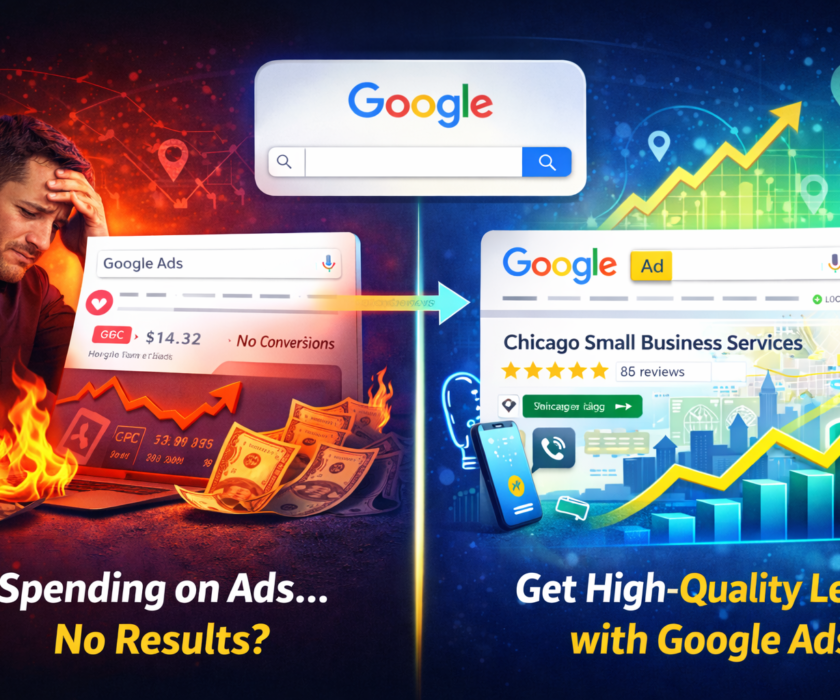
And if you’re driving paid traffic to your site, fixing conversion issues is even more urgent. Every dollar you spend on Google Ads for small business is wasted if the landing page isn’t built to convert. Fix the conversion leaks first, then scale the traffic.
At EmrixTech, we build websites that don’t just look great — they work. Every element is designed around conversion: the messaging, the structure, the speed, the mobile experience, and the calls to action. If your current site isn’t delivering the results you need, we’d love to take a look at why.
Frequently Asked Questions About Small Business Website Conversion
What is a good conversion rate for a small business website?
For most small business websites, a conversion rate of 2–5% is considered healthy. That means for every 100 visitors, you should aim to generate 2–5 real inquiries, calls, or form submissions. High-performing websites with strong trust signals, clear CTAs, and highly targeted traffic can achieve 8–10%+ conversion rates. If you’re below 1%, something fundamental needs attention immediately.
How long does it take to improve website conversion rates?
Some improvements show results almost immediately — a clearer headline or better CTA can generate more inquiries within days. Larger structural changes or SEO improvements typically take 2–3 months to show measurable impact. Make one change at a time and measure the result so you know what’s actually working.
Do I need a new website to improve conversions, or can I fix my existing one?
In most cases, you can significantly improve small business website conversion without building a new site from scratch. Rewriting key headlines, improving page speed, adding social proof, and fixing mobile issues on your existing site often produces better results than a complete rebuild — faster and at lower cost. That said, if your site is built on outdated technology or has deep structural problems, a rebuild may be the smarter investment.
What tools can I use to track my website conversion rate?
Google Analytics 4 (GA4) is the industry-standard free tool for tracking conversions. You can set up “conversion events” to track form submissions, phone number clicks, or button interactions. Google Search Console is also essential for understanding how people find your site and which pages they’re landing on. Both tools are free and should be set up on every small business website.
How does page speed affect small business website conversion?
Page speed has a direct, measurable impact on conversion rates. Research consistently shows that every additional second of load time reduces conversions by 7% or more. A site that loads in 2 seconds will convert significantly better than the same site loading in 5 seconds — even with identical content and design. Speed optimization is one of the highest-ROI improvements you can make.
Can social media help improve my website conversion rate?
Social media drives targeted traffic to your website, giving your conversion rate more opportunities to work. It also builds brand familiarity — people who’ve seen your business on social platforms before visiting your site are far more likely to convert because they already have a level of trust. Our social media marketing services are specifically designed to drive high-intent traffic that converts.
Ready to stop guessing why your website isn’t converting? Our team at EmrixTech offers a free website review — we’ll identify the specific reasons your site isn’t generating leads and walk you through a clear, prioritized action plan.
Get Your Free Website Review →
Related Reading
- 📊 How to Rank Your Business on Google in 2026: A Practical SEO Guide
- 📍 Local SEO in Chicago: The Complete 2026 Guide for Small Businesses
- 💻 Web Design for Small Business in Chicago: What It Costs & How to Choose
- 📢 Google Ads for Small Business in Chicago: Is It Worth It?
- 🤖 Generative Engine Optimization (GEO): How to Rank in AI Search 2026