DEVELOPMENTMARKETING
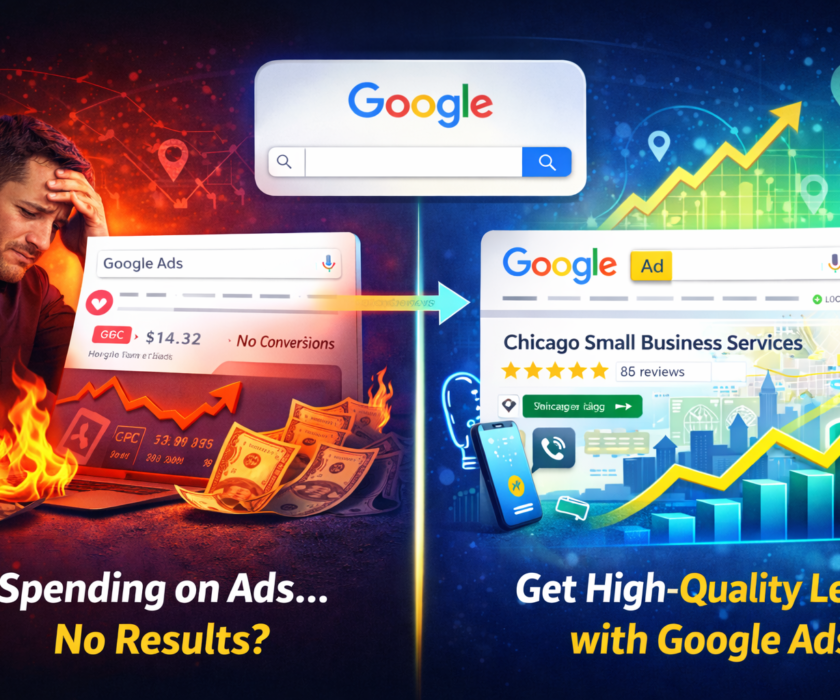
Google Ads for small business is one of the most debated topics in digital marketing. Some business owners swear by it — they run campaigns that generate five qualified leads a day at a cost that makes obvious financial sense. Others have spent thousands of dollars and seen almost nothing in return. So which is it? Is Google Ads worth the investment for your small business in Chicago in 2026?
The honest answer is: it depends — but the factors that determine success or failure are very predictable, and this guide lays all of them out clearly. After managing Google Ads campaigns for businesses across Chicago, the USA, UAE, Kuwait, and Australia, our team at EmrixTech has seen exactly what separates campaigns that deliver consistent ROI from those that drain budgets without results.
How Google Ads Actually Works (In Plain English)
Google Ads is a pay-per-click (PPC) advertising platform. You create ads that appear at the top of Google search results when someone searches for the specific keywords you’re targeting. You don’t pay for the ad to appear — you only pay when someone actually clicks on it. Hence: “pay-per-click.”
The cost per click varies enormously by industry and keyword competition. Some clicks cost $0.50. Others — in industries like legal services, insurance, or financial services — cost $50–$100 per click. Most small business keywords in Chicago fall somewhere in the $2–$15 range, depending on the category and how many competitors are bidding on the same terms.
Google decides which ads appear and in what order using an “Ad Auction.” Your position isn’t purely a function of how much you bid — Google also factors in your Quality Score, which measures how relevant your ad and landing page are to the search query. A highly relevant ad with a strong landing page can outrank a bigger-budget competitor with a poor-quality ad. That levels the playing field — somewhat — for smaller businesses competing against larger ones with deeper pockets.
When Google Ads for Small Business Makes the Most Sense
Google Ads for small business isn’t the right tool for every situation. Here’s when it makes the strongest financial case:
When You Need Leads Now, Not in 6 Months
Unlike SEO, which takes months to build momentum, Google Ads can generate qualified traffic and leads within 24–48 hours of launching a campaign. If you’ve just opened a new business, launched a new service, or need to fill your pipeline quickly, Google Ads delivers speed that organic search simply cannot match. For businesses in growth mode, Google Ads and SEO working together is the most powerful combination — Ads fills the pipeline now while SEO builds the long-term foundation. Read our complete guide on how to rank your business on Google in 2026 to understand how the two channels complement each other.
When Your Service Has Clear Search Demand
Google Ads works best when people are actively searching for what you offer. Services like “emergency plumber Chicago,” “web design agency near me,” or “Google Ads management Chicago” have clear, high-intent search demand — people are looking right now, ready to act. If your offering has meaningful search volume and your customers make relatively quick purchasing decisions, Google Ads is well-suited to your situation.
When Your Profit Margins Support the Math
This is the calculation every business owner needs to run before committing to Google Ads. If your average customer is worth $200 and you’re paying $15 per click with a 3% conversion rate, your cost to acquire a customer is $500. That’s a bad deal. But if your average customer is worth $3,000 and your cost per acquisition is $400, that’s an excellent deal. Know your numbers — customer lifetime value, average project value, realistic conversion rate — before you run the first ad.
When You Want Fast, Real Data on What Messaging Works
Google Ads provides faster feedback than almost any other marketing channel. You can test two different headlines in a single week and know with real data which one drives more clicks and conversions. This makes it valuable not just as a lead generation tool but as a testing environment for the messaging you’ll then use across your website, social media, and other marketing channels.
When Google Ads for Small Business Is the Wrong Move
Being genuinely useful means being honest about when Google Ads is likely to disappoint:
- Your website isn’t converting. Google Ads sends traffic to your website. If your site has unclear messaging, poor mobile experience, or no compelling call to action, paid traffic won’t fix that — it’ll just make a broken funnel more expensive. Before investing in Google Ads, ensure your website is optimized to convert visitors into leads. A great ad sending traffic to a poor landing page is money straight down the drain.
- Your margins are too thin. If your average transaction is $50 and clicks cost $8, you simply cannot afford the acquisition cost. Low-margin, high-volume businesses often find Google Ads unworkable until they reach a scale where volumes compensate.
- There’s low search volume for your offering. If your target customers don’t search Google for your type of service, Google Ads won’t find them. Some offerings are better discovered through Instagram, LinkedIn, trade publications, or referrals — in those cases, other channels will serve you better.
- You don’t have time to manage it properly. A poorly managed Google Ads account burns through budget faster than almost any other marketing mistake. Campaigns require regular attention — keyword refinement, negative keyword management, bid adjustments, and ad testing. “Set it and forget it” is a guaranteed way to waste money.
How Much Does Google Ads Cost for a Small Business in Chicago?
There’s no one-size-fits-all answer, but here are realistic budget benchmarks for Chicago small businesses running Google Ads in 2026:
- Minimum effective budget: $500–$1,000/month. Below this threshold in most Chicago markets, you don’t collect enough data to optimize, and you’ll exhaust your daily budget before reaching the majority of potential customers searching for you.
- Recommended starting budget for most small businesses: $1,500–$3,000/month. This allows enough volume to test what resonates, optimize campaigns based on real data, and generate a meaningful number of leads each month.
- Highly competitive Chicago categories (legal, financial services, real estate, insurance, medical): $5,000–$15,000+/month to compete effectively against established players with large budgets.
- Agency management fees: Typically 15–20% of ad spend, or a flat monthly retainer. This is separate from your advertising budget — it covers the expertise to make that budget work much harder than it would unmanaged.
Keep these numbers in context: if a single new client is worth $5,000 to your business, spending $2,000/month to acquire two new clients per month is an excellent return. The raw dollar amount matters far less than the math behind it.
Google Ads vs SEO: Which Is Better for Small Business?
This is the question we hear most often, and the genuinely useful answer is: they serve different purposes, and the best-performing small businesses use both. Here’s how to think about the choice:
- Google Ads: Immediate visibility, you pay for each click, traffic stops the moment you pause spending, best for filling short-term pipeline gaps or launching new offerings quickly
- SEO: Slower to build, but clicks are free once you rank, compounds over time, produces traffic that doesn’t disappear when you pause a campaign
The ideal strategy for most Chicago small businesses is to use Google Ads to generate leads now while simultaneously building long-term SEO authority. As your organic rankings improve, you reduce dependence on paid traffic. Read our full guide on how to rank your business on Google in 2026 to understand the SEO side of this equation in detail. And if you’re specifically targeting Chicago customers, our Local SEO Chicago guide covers the map pack and neighborhood-specific strategies that drive the most qualified local traffic.
The 5 Most Common Google Ads Mistakes Small Businesses Make
After managing Google Ads campaigns for small businesses across Chicago and internationally, our team sees the same costly mistakes appear again and again:
- Targeting keywords that are too broad. Bidding on “marketing” or “web design” will burn through your daily budget on completely irrelevant clicks within hours. Target specific, intent-driven phrases: “web design company Chicago small business” — not just “web design.”
- Ignoring negative keywords. Negative keywords tell Google which searches you do NOT want to appear for. Without them, you’ll pay for clicks from people looking for jobs at your competitors, free tools, tutorials, or entirely unrelated searches. This single fix typically cuts wasted spend by 30–50%.
- Sending all ad clicks to the homepage. Your homepage serves general visitors. Paid search visitors need a targeted landing page that matches exactly what they searched for and has one clear, single call to action. Campaigns with dedicated landing pages convert 2–5x better than those directing traffic to the homepage.
- Not setting up conversion tracking. If you don’t know which keywords and ads are generating actual leads (not just clicks), you have no basis for optimization. Conversion tracking is not optional — it’s what separates professional campaign management from expensive guessing.
- Setting it and forgetting it. Google Ads demands regular attention. Bids, keywords, ad copy, and budgets should be reviewed and refined at least weekly — especially in the critical first 90 days when the algorithm is learning your campaign.
What Results Can You Realistically Expect from Google Ads?
Realistic expectations vary by industry, competition, and how well your campaign is managed. As a general benchmark for well-managed small business Google Ads campaigns in competitive markets like Chicago:
- Month 1: Campaign setup, initial data collection, early optimization. Expect some leads but higher costs as the algorithm learns.
- Months 2–3: Data accumulates, optimization becomes meaningful, cost per lead typically drops 20–40% as you refine keywords and bids.
- Months 4–6: Campaigns reach a more mature, stable performance level. This is where you have enough data to make genuinely strategic decisions about scaling.
Google Ads is not a lottery. Managed well, with proper tracking and consistent optimization, it’s one of the most predictable and scalable lead generation channels available to small businesses. Managed poorly — or not at all — it’s one of the fastest ways to lose money in marketing.
One more thing worth knowing: as AI search grows in 2026, there’s an emerging channel called Generative Engine Optimization (GEO) — getting your content cited inside ChatGPT, Perplexity, and Google AI Overviews. It’s not a replacement for Google Ads or SEO, but it’s a fast-growing visibility layer worth understanding alongside your paid strategy.
Frequently Asked Questions: Google Ads for Small Business
How quickly can I see results from Google Ads?
Ads can go live within hours of campaign setup, and traffic typically starts flowing within 24–48 hours. Whether that traffic converts into leads depends on your landing page quality, your offer’s relevance, and how well your keywords match what people are actually searching for. Most businesses see their first conversions in the first week, with campaigns improving meaningfully over the first 30–90 days as performance data accumulates.
Can I run Google Ads myself, or do I need an agency?
You can run Google Ads yourself — Google has made the interface relatively accessible, and free resources for learning the basics are widely available. However, poorly managed campaigns routinely waste 30–60% of their budgets on irrelevant clicks, overbroad targeting, and poor landing page alignment. An experienced agency typically generates significantly better returns even after accounting for management fees. Our Google Ads management services in Chicago are built specifically for small businesses that want expert-managed campaigns without enterprise-level pricing.
What is a good conversion rate for Google Ads?
Average Google Ads conversion rates vary widely by industry, but 3–5% is a general benchmark for service businesses. Well-optimized campaigns with highly targeted keywords, strong ad copy, and dedicated landing pages can achieve 8–12%+ conversion rates. If you’re converting below 1–2%, your landing page experience or keyword targeting needs significant attention before increasing your budget. Our guide on why small business websites don’t convert identifies the most common landing page problems and how to fix them.
What is the minimum budget for Google Ads to be effective?
As a practical rule, $500/month is an absolute floor for most Chicago service businesses, and $1,500–$3,000/month is where you start generating enough data to optimize meaningfully. For competitive categories or aggressive growth goals, $5,000–$10,000/month is more realistic. Below the effective threshold, your daily budget runs out before most searches happen, and you never accumulate the data needed to improve.
Should I use Google Ads or Facebook Ads for my small business?
Google Ads captures existing demand — people who are actively searching for what you offer right now. Facebook Ads creates demand — it targets people based on demographics and interests, whether or not they’re searching for you. For service businesses where customers actively search (contractors, agencies, legal, medical, home services), Google Ads typically converts at higher rates. For impulse purchases, lifestyle products, or businesses where visual storytelling drives decision-making, Facebook and Instagram Ads often outperform. Many successful small businesses run both, addressing the full customer journey from awareness to conversion.
How do I know if my Google Ads campaigns are actually working?
The non-negotiable metric is cost per acquisition (CPA) — what you’re spending to generate each qualified lead or sale — compared to the value of that customer to your business. Secondary metrics like click-through rate (CTR), quality score, impression share, and conversion rate tell you what’s working and what needs improvement within the campaign. If you can’t see and track these numbers, your campaign isn’t properly set up for optimization.
Thinking about running Google Ads for your small business in Chicago — but not sure where to start or whether it makes sense for your specific situation? Our team at EmrixTech offers a free Google Ads consultation. We’ll review your business, competition, and goals — and give you an honest assessment of whether Google Ads is right for you, what budget you’d need, and what realistic results look like.
Book Your Free Google Ads Consultation →
Related Reading
- 📊 How to Rank Your Business on Google in 2026: A Practical SEO Guide
- 📍 Local SEO in Chicago: The Complete 2026 Guide for Small Businesses
- 💻 Web Design for Small Business in Chicago: What It Costs & How to Choose
- 🔁 Small Business Website Not Converting? 7 Honest Reasons
- 🤖 Generative Engine Optimization (GEO): How to Rank in AI Search 2026