TECHNOLOGY
What Is Answer Engine Optimization?
Answer Engine Optimization is the practice of structuring your website content so that AI-powered tools — answer engines — select it as the source when generating responses to user questions. Where traditional SEO aims to rank your page in Google’s blue links, AEO aims to get your content cited or featured inside the AI-generated answer itself.
The term covers optimisation for Perplexity AI, ChatGPT Search, Microsoft Copilot, Google AI Overviews, and voice assistants — any system that synthesises information and delivers a direct answer rather than a list of links.
AEO vs SEO vs GEO — What’s the Difference?
- SEO (Search Engine Optimization) — Optimising for Google’s blue-link rankings. Goal: page 1. Measured by ranking position and organic clicks.
- GEO (Generative Engine Optimization) — Optimising for AI-generated content from large language models. EmrixTech has published extensively on GEO.
- AEO (Answer Engine Optimization) — The broadest category, covering all answer-generating systems. GEO is a subset of AEO.
Which AI Platforms AEO Targets in 2026
- Google AI Overviews — Present on 15–20% of queries, especially informational searches.
- Perplexity AI — Pulls from live web results and cites sources visibly. Learn how to rank on Perplexity.
- ChatGPT Search — OpenAI’s search integration, growing rapidly among professional users.
- Microsoft Copilot — Uses Bing indexing. Significant enterprise adoption.
- Voice assistants (Siri, Google Assistant, Alexa) — Tens of millions of local queries daily.
5 AEO Tactics to Implement This Week
1. Structure Content Around Direct Questions and Direct Answers
Every H2 should be a question your customers ask. The first paragraph under that heading should give a clear, complete answer in 1–2 sentences. AI tools extract this answer-first structure reliably. Traditional long introductions before the answer perform poorly in AI selection.
2. Add FAQ Schema to Every Service and Blog Page
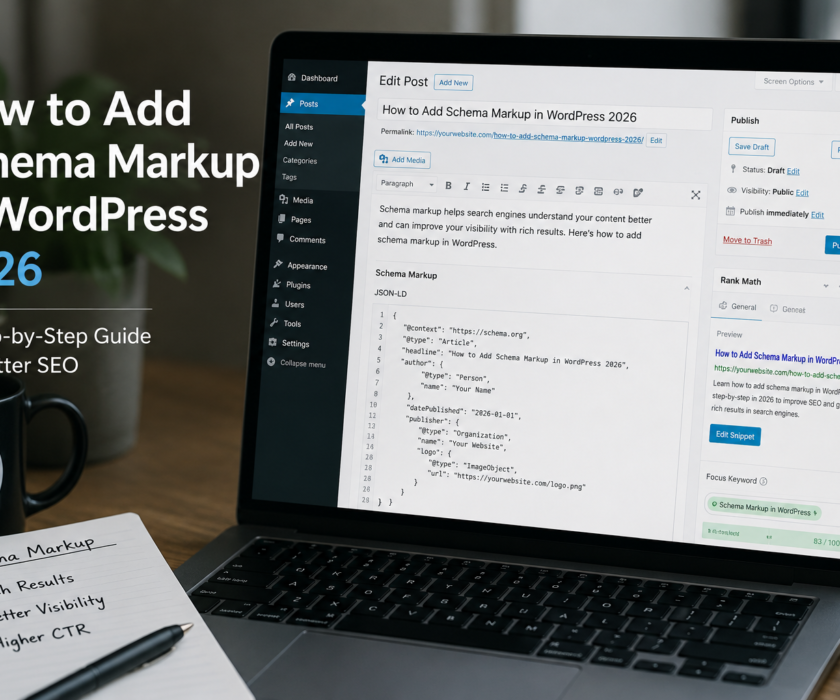
FAQ schema markup tells AI tools exactly where your Q&A content is. In Rank Math, add the FAQ block at the bottom of every page with 5–8 genuine customer questions. Google uses FAQ schema to populate AI Overviews. See our full guide on adding schema markup in WordPress.
3. Build Authority with External Citations
AI tools are more likely to cite sources that are themselves cited elsewhere on the web. Get listed on Clutch, DesignRush, and local business directories. Even a few quality external links to a page significantly improve its AI citation probability.
4. Submit to Bing Webmaster Tools
Perplexity AI, ChatGPT Search, and Microsoft Copilot all index primarily through Bing — not Google. Log into Bing Webmaster Tools (free), verify ownership, and submit your sitemap. Takes 15 minutes and immediately improves visibility across all Bing-powered AI tools.
5. Use Clear Entity Signals
Make sure your business name, address, service area (Chicago and suburbs), and core services are clearly stated on your homepage, About page, and in your LocalBusiness schema. AI tools need unambiguous signals about who you are before they’ll cite you confidently.
How to Measure AEO Performance
- Google Search Console — Check ‘AI Overviews’ filter in Search type to see appearances and clicks.
- Manual Perplexity checks — Search your target keywords in Perplexity monthly and note whether emrixtech.com appears as a cited source.
- GA4 referral traffic — Filter for perplexity.ai and chat.openai.com referrals.
- Branded search growth — AI discovery often leads to direct brand searches. Track in Search Console over time.
AEO isn’t a replacement for local SEO — it’s a layer on top of it. Need help with AEO or GEO for your Chicago business? Contact EmrixTech for a free audit.